Social Security Has Been Here Before
by Corey Sunstrom, CFP®
Director of Financial Planning
Why the system is under pressure, what happened the last time it needed a rescue, and what Congress could do next
A few weekends ago, Lizy and I packed up the car for what turned into roughly a ten-hour drive to Maryland for a cabin weekend with some of our friends from Washington, D.C. Emmy was asleep in the back seat, which created one of those rare parenting situations where you are grateful for the silence for about twenty minutes and then realize you still have several hundred miles of highway ahead of you.
Eventually, we reached the stage of a long road trip where just about anything qualifies as entertainment. So naturally, we listened to a Planet Money podcast about the looming financing problem with Social Security.
Nothing says “weekend getaway” quite like actuarial insolvency.
The episode was good enough that Social Security followed us all the way into the cabin. This particular group of friends has spent enough time around Washington that seemingly innocent conversations have a tendency to become policy debates, usually without anyone formally agreeing that a policy debate has begun. Before long, we had people arguing for raising taxes, people arguing that benefits needed to change, questions about whether wealthy retirees should receive the same benefits, and the predictable discussion about whether younger generations will ever see any of this money themselves.
The interesting thing was that almost everybody had a defensible point, and that is largely what makes Social Security so difficult to fix.
The podcast featured R. Douglas Arnold, a retired Princeton professor and author of Fixing Social Security: The Politics of Reform in a Polarized Age. His central argument is surprisingly simple. Social Security does not have an unsolvable financial problem. Congress can raise more money, pay less money, restructure the program, or use some combination of those approaches. The hard part is political: every solution imposes a cost on somebody.[1,2]
The problem is deciding who gets the bill.
And before getting into what Congress might do next, it helps to understand how we got here, because Social Security has never really been a finished product. It has been modified, expanded and repaired repeatedly for more than ninety years.
How Social Security Actually Started
Social Security was created in 1935 in a very different America. The country was still working its way through the Great Depression, and economic insecurity among older Americans was widespread. The program was designed to provide a basic layer of income for older workers and their families.[3,4]
When payroll taxes began in 1937, employees paid 1% of wages and employers paid another 1%, and the tax applied only to the first $3,000 of annual earnings.[5,6]
That $3,000 limit matters because Social Security has always had a taxable earnings cap. The cap was not a modern carve-out invented for high earners. It was part of the original design, with both taxable wages and eventual benefits limited.
Over the following decades, Congress repeatedly expanded the system. More workers were covered, survivor and dependent benefits grew, disability insurance was added, payroll tax rates increased, and the taxable wage base was raised. By 1950, the combined employee-employer Social Security tax rate had risen from 2% to 3%, and the rate continued climbing over subsequent decades.[6,7]
For much of Social Security’s early history, Congress was not particularly shy about adjusting the program. If the financing or benefit structure no longer fit the economy, lawmakers came back and changed it.
Then Congress Put More of the System on Autopilot
A major shift came in the 1970s. Before automatic cost-of-living adjustments, Congress periodically had to vote to increase benefits. The 1972 amendments created automatic inflation adjustments and also established mechanisms that ultimately led to regular increases in the taxable wage base as wages rose.[8,9]
That was a sensible modernization. Retirees no longer had to depend on Congress noticing that groceries, rent and medical costs had become more expensive.
But the 1972 legislation also created an unintended financing problem. The interaction of wage indexing and inflation indexing caused future benefits to grow faster than lawmakers had intended. Congress responded again in 1977, revising the benefit formula, increasing future tax revenues and changing the wage-base rules.[4,10]
Even after that repair, the economy delivered another unpleasant surprise. High inflation, weak real wage growth and unemployment put more pressure on the program, and by the early 1980s Social Security was approaching an immediate financing crisis.
The 1983 Rescue
By the early 1980s, the problem was no longer a distant actuarial forecast. The Old-Age and Survivors Insurance Trust Fund was facing the possibility that it would be unable to pay full benefits on time. President Ronald Reagan and congressional leaders turned to the National Commission on Social Security Reform, commonly called the Greenspan Commission, to develop a package that could pass Congress.[11,12]
The eventual 1983 legislation is worth studying because it is a useful historical guide for what a future Social Security deal could look like. There was no single miracle provision. Congress spread the adjustment across several groups.
The 1983 amendments accelerated previously scheduled payroll-tax changes, brought newly hired federal employees into Social Security, increased taxes on self-employed workers, delayed one cost-of-living adjustment, and made a portion of Social Security benefits taxable for some higher-income beneficiaries. The law also gradually increased the full retirement age from 65 to 67.[12,13]
That last point matters. Congress did not tell someone standing on the doorstep of retirement that the rules had changed overnight. The retirement-age increase was phased in over decades, giving younger workers time to plan around it.
The reforms also helped create substantial future Social Security surpluses. The baby boom generation was still working, so payroll tax revenue exceeded benefit payments for many years. Those excess dollars accumulated in the trust funds and were invested in special U.S. Treasury securities. As the baby boomers later retired, the system began drawing those reserves down, which is exactly what a reserve is supposed to do.[14,15]
What Changed After 1983
The 1983 reforms were designed to restore long-term actuarial balance, but several important trends turned out differently than expected. Americans lived longer in retirement, fertility fell below earlier assumptions, the recovery from the 2008 financial crisis was unusually slow, and earnings growth became increasingly concentrated among higher earners.[1,16]
The wage distribution point is especially important because it connects directly to the Social Security taxable maximum.
From 1937 through 1950, the taxable maximum remained $3,000. Congress then raised it periodically. Since the mid-1970s, the maximum has generally risen with average wages, and since the early 1980s the indexing mechanism has operated consistently.[5,17]
In 1937, about 92% of covered earnings were below the taxable maximum. The share moved around considerably over the following decades and reached about 90% in 1983. Since then, earnings above the cap have grown faster than earnings below it. The Social Security Administration has specifically identified that change in earnings distribution as the reason a smaller share of total covered wages is now taxed.[17,18]
That does not mean the cap stopped rising. It means income above the cap rose even faster.
This is important because one of the most common reform proposals is not simply ‘raise taxes on the rich.’ A more precise version is to ask whether the taxable wage base should once again capture a larger percentage of total covered earnings, closer to the share it captured in the early 1980s.[17,18]
Where We Are Today
Today, Social Security’s cost is greater than its dedicated program income, and the system is using trust-fund reserves to make up the difference. Under the 2026 Trustees’ intermediate assumptions, the Old-Age and Survivors Insurance Trust Fund, which finances retirement and survivor benefits, can pay 100% of scheduled benefits through the fourth quarter of 2032.[19,20]
This is where the language around Social Security often gets sloppy.
The trust fund being depleted is not the same thing as Social Security disappearing.
Even after the reserve is exhausted, workers and employers would still be paying payroll taxes. Under the 2026 Trustees’ intermediate assumptions, continuing income would be enough to pay about 78% of scheduled OASI benefits at the point of reserve depletion.[19,20]
That is still a major problem. It is just a different problem than ‘Social Security goes to zero.’
If someone were scheduled to receive $4,000 per month and the system could pay only 78% of that amount, the math works out to about $3,120. A $3,000 scheduled benefit would be roughly $2,340, and a $2,000 benefit would be roughly $1,560. Those examples are not predictions of what Congress will allow to happen or what any individual will ultimately receive. They simply illustrate the size of the current-law financing gap if lawmakers make no changes.[19]
Arnold’s book is especially useful here because it explains why delay is politically attractive. Raising taxes creates visible losers now. Reducing benefits creates visible losers now. Raising the retirement age creates visible future losers. Doing nothing creates almost no immediate political pain, until the date of trust-fund depletion gets close enough that inaction becomes its own very large political decision.[2,21]
What Could Congress Actually Change?
The Planet Money episode walked through several major reform ideas, and Arnold’s book provides the broader political framework for thinking about them. The choices fall into a few basic categories: raise revenue, slow future benefit growth, change eligibility rules, broaden the pool of workers supporting the system, or combine several smaller changes.
The table below is not a prediction of legislation. It is a way to see the levers Congress actually has and, just as importantly, who would feel each change.
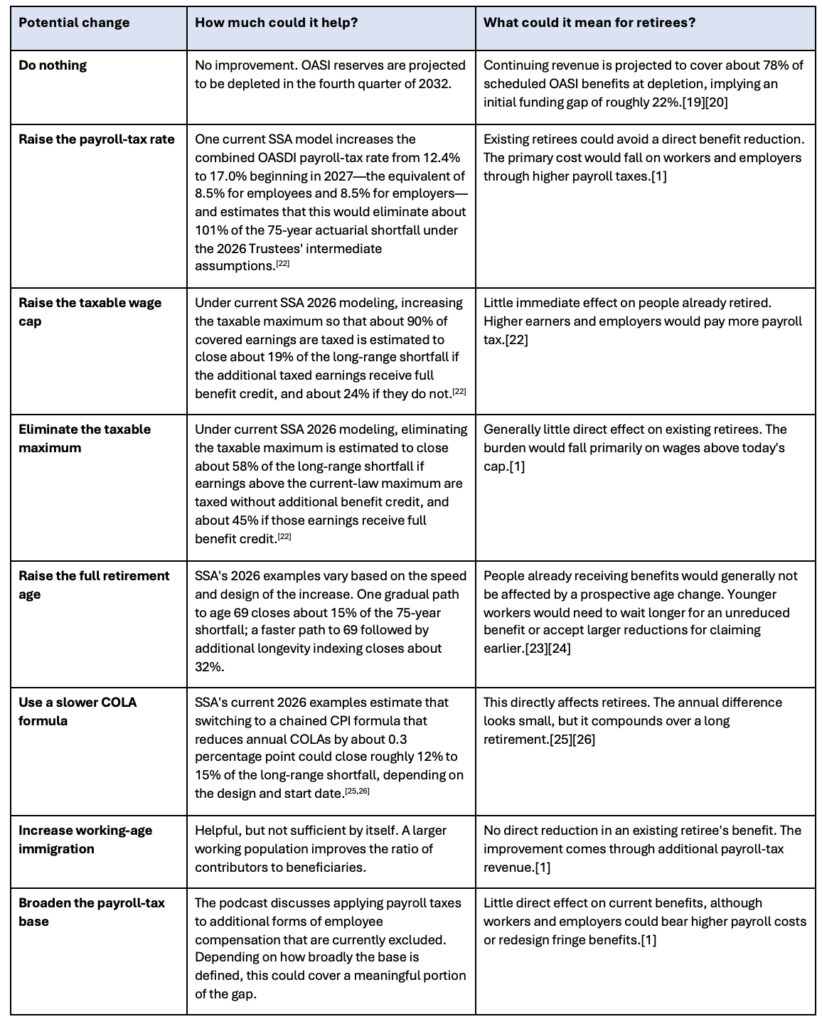
The important conclusion is not that one of these ideas is obviously correct. It is that Congress has a lot of ways to improve the math, and nearly every one comes with a tradeoff.
And Then There Is Canada
One of the most interesting parts of the Planet Money discussion is the comparison with Canada. In the 1990s, Canada faced a serious long-term financing problem in the Canada Pension Plan. Federal and provincial governments responded in 1997 with a package that increased contribution rates in the short run, restrained the growth of some future benefits, and moved the plan toward a larger funded reserve.[1,27,28]
Canada also created a structure in which cash not needed to pay current benefits could be invested in financial markets through the CPP Investment Board, rather than keeping the system almost entirely on a pay-as-you-go footing. Canada’s official history describes the objective as building a reserve, stabilizing the relationship between assets and expenditures, and seeking higher long-term returns on assets not needed for current benefits.[27]
That distinction is important. Canada did not discover free money. Canadians paid more into the system and made benefit-side adjustments first. The investment pool then had decades to compound.
The United States discussed market investment of Social Security reserves in the 1990s, but it never built the kind of large, professionally invested reserve Canada did. As Goss explains in the podcast, doing it today would be much less powerful because the U.S. trust fund is already being drawn down. There is simply less capital left to put to work.[1]
There is probably a financial-planning lesson buried in there somewhere: compounding is very useful, but it works best when you start before you desperately need it.
What I Think Retirees Should Take From All of This
The Social Security problem is real. I also think the conversation around it is frequently more frightening than useful.
Social Security is not scheduled to disappear in 2032. Under current projections, the OASI trust fund is scheduled to exhaust its accumulated reserves, after which ongoing tax revenue would initially cover about 78% of scheduled retirement and survivor benefits if Congress did nothing.[19,20]
I have a hard time imagining Congress choosing ‘do nothing and explain a roughly 22% benefit shortfall to tens of millions of retirees’ as its preferred political strategy. That is a political judgment, not a guarantee that Congress will act before reserve depletion.
That does not mean I know what the eventual legislation will look like. I don’t.
One plausible path, consistent with the 1983 precedent, would be a package that pulls several levers rather than a dramatic reinvention of American retirement. Higher-income workers could pay more. The payroll-tax rate could rise gradually. Younger workers could face a somewhat later full retirement age. Cost-of-living or benefit formulas could change at the margins. Lower-income retirees and people with long or physically demanding careers could receive special protections. Congress could choose a materially different approach, but that kind of mixed package is consistent with Arnold’s argument that a durable solution is more likely to come from combining adjustments than pretending one constituency can absorb the entire cost.[2,21]
Everyone may dislike one piece of it. Historically, that is usually what a compromise looks like.
For people already retired or approaching retirement, I would be very careful about allowing headlines about Social Security ‘running out’ to dictate a claiming decision today. Whether someone claims at 62, full retirement age or 70 should still be driven primarily by longevity, marriage, taxes, cash-flow needs, other assets, how Social Security fits into the larger retirement plan, and the rules in effect when the decision is made.
The system needs another repair. It has needed repairs before.
And perhaps the most useful lesson from both Arnold’s book and the history of Social Security is that the question has never really been whether we have the tools to fix it.
We do.
The harder question is how long we wait, and how we ultimately decide to split the bill.
Safeguard Your Finances With Pro Guidance
Want to learn more about Social Security and how it may impact your finances? You don’t have to navigate this complex terrain alone. Working with an advisor can help you understand your options.